


Frédéric Halbreich Belg, 1962
Unique lacquer painting effect
17kg
47 1/4 x 39 3/8 in
• Free Worldwide Art Shipping (DDU)
• Professional Art Packing
• Full Insurance & Gallery Guarantee
• Certificate of Authenticity by Artist & Gallery
• Enquire a Welcome Offer for your 1st Collection
Further images
-
(View a larger image of thumbnail 1
)
-
(View a larger image of thumbnail 2
)

-
(View a larger image of thumbnail 3
)

-
(View a larger image of thumbnail 4
)

-
(View a larger image of thumbnail 5
)

-
(View a larger image of thumbnail 6
)

-
(View a larger image of thumbnail 7
)
-
(View a larger image of thumbnail 8
)

-
(View a larger image of thumbnail 9
)
-
(View a larger image of thumbnail 10
)
-
(View a larger image of thumbnail 11
)
-
(View a larger image of thumbnail 12
)

-
(View a larger image of thumbnail 13
)

-
(View a larger image of thumbnail 14
)

-
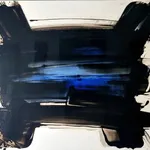
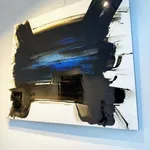
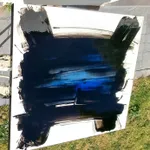
“VENETUS LEO AD OPUS” is a painting that captures the essence of energy in its purest form. A powerful composition of deep black gestures, suspended light, and a vibrant blue core, it feels like a force in motion — a presence rather than an image.
Frédéric Halbreich works with a language that is both abstract and instinctive. The brushstrokes are bold, almost calligraphic, yet perfectly balanced. The black mass does not weigh down the composition — it breathes, it expands, it opens. At its center, a subtle blue light emerges, like a pulse, a horizon, or a passage through darkness.
This painting evokes something universal: movement, tension, and transformation. It feels like a moment of transition — between shadow and light, between stillness and expansion. The work is both powerful and meditative, creating a rare balance between intensity and calm.
Collectors are drawn to this piece because it creates an immediate emotional impact while continuing to reveal new layers over time. It is a painting that changes with the light, with the space, and with the viewer. It does not impose itself — it resonates.
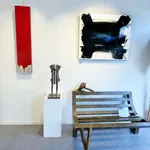
Placed in an interior, this work becomes an anchor. It brings depth, structure, and a strong artistic presence:
above a bench or console, where it creates a powerful horizontal dialoguein a living room, as a bold and refined focal pointin a minimalist or architectural space, where its energy can fully expandin a collector’s environment, where materiality and gesture are appreciated.This is a painting for a collector who seeks more than decoration — someone who is sensitive to gesture, to balance, to the invisible energy within a work.
“VENETUS LEO AD OPUS” is not just a painting — it is a field of energy, a moment of transformation, a presence that lives within the space.
Provenance
We know the works of Frédéric Halbreich in lacquer, medium of which he is indeed the only artist to have developed his own technique of lacquer and to sparkle the preciousness in the pure art of his abstraction.
The material support of this journey towards elsewhere is lacquer, a means of expression that sets Frédéric Halbreich apart from any painter past and present. It also differentiates him from the great models and references such as Franz Kline and Pierre Soulages.
"The art of lacquer in pure art".
What interests him is the light.
In his lacquers, he brings it out from inside the painting, through the vector of transparency.
He calls "sacrophage" the support on which he creates his lacquers.
Besides these, there are his canvases: oils and acrylics where he derives his expression more from gesture.
Like lacquer work, these pictorial layers (pigments) – ten or more in number – each require an appropriate time to dry. Then follow new meticulous sanding intended to eliminate scratches or accidents.
At the same time, lacquer acts like a mirror, in which the spectator may discover a reality far beyond his own reflection, even a possible answer to his own existential questions.
As an indispensable counterpoint to that mirror which sends the pictorial even beyond abstraction, here are mat surfaces, paradoxically less black in their opacity.